


At My Science Club, we’ve been reflecting on our climate impact. Since our resources reach hundreds of schools globally, we have a unique opportunity to inspire and inform young people through both our words and our actions.
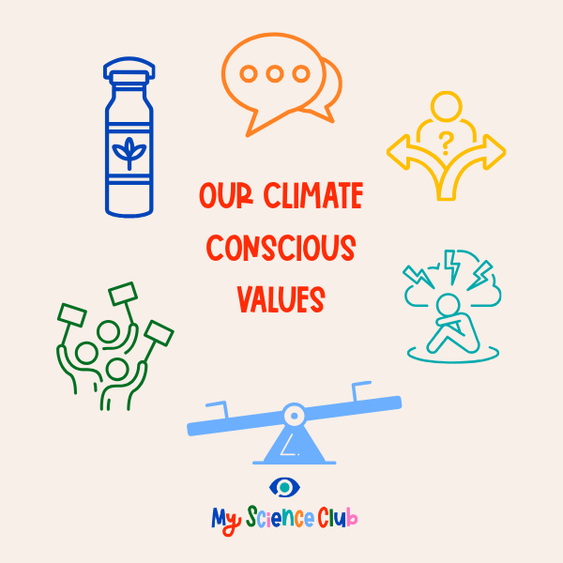
To hold ourselves accountable, we’ve developed a set of Climate Conscious Values. These principles now guide everything we do, from how we design our science club sessions and choose the materials we use to the way we support educators to engage with some of the big issues we face.
Here are our six Climate Conscious Values:
Give your science clubbers a voice about issues that matter to them

Build time into sessions for your science clubbers to talk about the issues that matter to them. It might be something they’ve seen or heard on the news and have questions about, or it could be an activity during the science club that sparks a bigger question.
Take time to listen to their concerns and ideas, write down any questions they have – these can be answered at a later date after some research into the answers.
Raise Awareness of cause and effect

Always highlight the links between the changes that are happening and the impact those changes are having. It is important to highlight the positive human impacts as well as the negative ones. Don’t shy away from talking about the underlying human impacts that are causing climate change though, your science clubbers will know if you’re not being honest!
Talk about the subject in a science-based way, try not to attribute blame to individuals or a group of people. Whenever you talk about climate change impacts, talk about the solutions that are being developed as well.
In basic terms, a number of human activities produce large amounts of carbon dioxide which collects in the atmosphere. Carbon Dioxide is a greenhouse gas and traps heat from the sun which leads to Earth warming up (Global Warming). The increased average temperature of Earth’s surface is causing the climate to change in a variety of ways.
Enable informed decision making through science literacy

Take every opportunity to share climate related stories that are in the news – both positive and negative. Share examples of social media content and give children opportunities to discuss them in a critical manner. Ask them questions about sources, reliability, bias and credibility. Give them opportunities to fact check information and ask critical questions about the media they are consuming.
Ensure children have a good understanding of the basic science behind climate change, the causes, the effects and the impacts. Teach them about the atmosphere, the greenhouse effect and how increasing concentrations of CO2, in particular, are driving climate change.
Having a solid understanding of the science of climate change gives children the confidence they need to be able to effectively evaluate information from the media.
Be resource conscious

We have thought very carefully about the resources, and consumables, that are used in our sessions and have made sure that as much as possible things are reused multiple times. We try to limit the consumable resources that are needed, avoid food that is wasted in activities and suggest sustainable alternatives wherever possible.
When you’re running a science club it is important to consider the resources you are using, are they reusable? If not, can they be recycled, or is there an alternative?
A simple letter home to families can be a great way of collecting resources that you might need such as yoghurt pots, plastic tubs, bottles, cardboard etc.
Be aware of, and empathetic to, climate anxiety

Always listen to the children’s conversations and acknowledge their concerns about climate change. Encourage children to share with each other so they can appreciate that they are not alone in thinking the way that they do.
Spend time highlighting the actions that individuals can take to make a difference and how by working collectively we can amplify that difference.
There is lots of research into climate anxiety in children that it is well worth reading.
This journal article explores the emotional responses to climate change education.
This blog explores the question: Nature – a source of solace or anxiety for children and young people?
Empower positive collective action and responsible citizenship

Research has shown that participating in action can really help children who are feeling anxious. Ensure that you give all children opportunities to participate in activities where they can see the difference they are making. It could be a recycling project, an energy saving campaign or a community litter pick – as long as they are working collectively and understand how they actions are having a positive impact.
Ensure children are involved in the decision-making processes about the projects, events and campaigns that they want to be involved in. Having a focused eco group, or sustainability champions can help gather views and ideas from across the whole school community. They can be responsible for planning activities and communicating what’s being done.
As children move through the school support them to grow their world view and their understanding of how climate change is a global challenge. Explore the ways that the actions of people in certain parts of the world can have an impact on people in other parts. Give children an opportunity to research and discuss issues such as Climate Justice, global trade and the impact of the COP conferences.
Click here to download a your FREE copy of our Climate Conscious Values posters.
And finally, if you enjoyed our blog and free resources and want to find out more about My Science Club and becoming a member click here for more information. We’re also giving you a superb 25% discount on becoming a full member for 12 months, just add the code MSCClimate at checkout which is valid until the end of September 2026!
Bryony and Paul
Founders and creators of My Science Club

